

Most visitors come to St. Augustine for its Spanish colonial landmarks, centuries‑old architecture, and postcard‑perfect streets. But the Ancient City also holds a powerful place in modern American history. In 1963 and 1964, St. Augustine became one of the most volatile and nationally significant battlegrounds of the Civil Rights Movement. What unfolded here helped push the Civil Rights Act of 1964 across the finish line and permanently shaped the nation’s understanding of segregation, resistance, and justice.
As we observe Martin Luther King Jr. Day, Old City invites you to explore the places, people, and stories that define St. Augustine’s civil rights legacy. From Lincolnville’s community leaders to the steps of the former Monson Motor Lodge, these sites tell a story of courage, sacrifice, and perseverance that deserves to stand alongside Birmingham, Selma, and Montgomery in the national memory.
Why St. Augustine’s Civil Rights Story Matters
Before national headlines turned toward St. Augustine, local residents were already risking everything to challenge segregation in their own backyard.
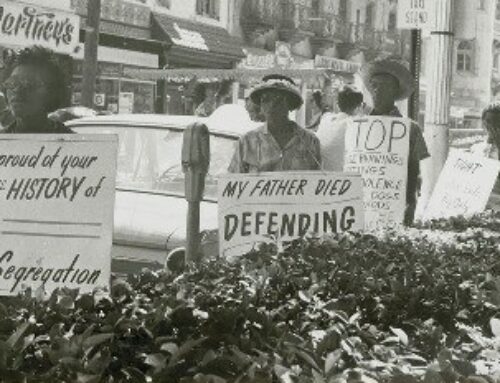
In the early 1960s, St. Augustine was preparing for a global celebration of its 400th anniversary, scheduled for 1965. Yet beneath the anniversary planning and tourist marketing, segregation remained firmly in place. Despite the Supreme Court’s 1954 Brown v. Board of Education decision, public schools were still segregated. Restaurants, hotels, beaches, and swimming pools enforced whites‑only policies. Black residents were excluded from many jobs, businesses, and even from participating in anniversary planning events.
St. Augustine’s Black population, numbering just a few thousand residents, lived primarily in the Lincolnville neighborhood and faced daily discrimination under Jim Crow laws. These conditions created the foundation for a local civil rights movement that would soon draw national attention.
At the center of this movement was Dr. Robert B. Hayling, a local Black dentist and Air Force veteran. Working closely with the NAACP Youth Council, Hayling began organizing sit‑ins, marches, and demonstrations in 1963. The response from white segregationists and the Ku Klux Klan was swift and violent. In September 1963, Hayling and three other activists were kidnapped and severely beaten by Klansmen. Rather than silencing the movement, the violence strengthened Hayling’s resolve.
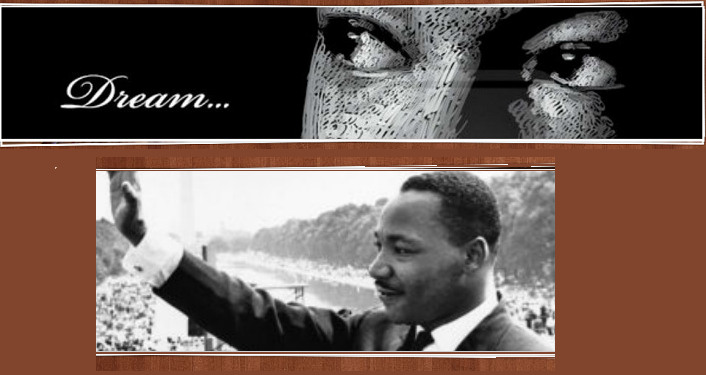
By early 1964, Hayling reached out to Dr. Martin Luther King Jr. and the Southern Christian Leadership Conference (SCLC) for assistance. King recognized St. Augustine’s strategic importance. The Civil Rights Act was stalled in a Senate filibuster, and King believed that sustained, highly visible demonstrations in the nation’s oldest city would generate the national pressure needed to move the legislation forward. Events in St. Augustine soon proved him right.
Lincolnville Museum and Cultural Center
This neighborhood museum serves as both a keeper of memory and a starting point for understanding how the Civil Rights Movement took root in St. Augustine.

A meaningful exploration of St. Augustine’s civil rights history begins at the Lincolnville Museum and Cultural Center, located in the heart of the historic Lincolnville neighborhood. The museum is housed in the former Excelsior High School, the city’s first public high school for African Americans and a longtime community anchor.
The museum’s exhibits trace more than four centuries of Black history in St. Augustine, with a strong focus on the Civil Rights Movement of the 1960s. Visitors encounter personal stories, photographs, documents, and artifacts that bring the era to life. Among the most moving items on display is Dr. King’s fingerprint card from his June 11, 1964 arrest in St. Augustine—his only arrest in Florida.
The museum also preserves the story of the St. Augustine Four, a group of local teenagers who staged a sit‑in at a segregated Woolworth’s lunch counter in July 1963. JoeAnn Anderson Ulmer, Audrey Nell Edwards, Willie Carl Singleton, and Samuel White were arrested and later offered their freedom if they agreed to stop protesting. Instead, they chose six months in reform school. Their decision drew national outrage and support, including advocacy from Jackie Robinson and Dr. King, and helped focus national attention on St. Augustine.
Through these exhibits, the Lincolnville Museum honors not only national leaders but also the local residents—students, parents, ministers, and neighbors—who sustained the movement day after day. The museum remains a vital starting point for understanding how deeply the Civil Rights Movement was rooted in this community.
The Monson Motor Lodge Site
Few places in America produced images as shocking—or as influential—as those captured on the bayfront in June 1964.
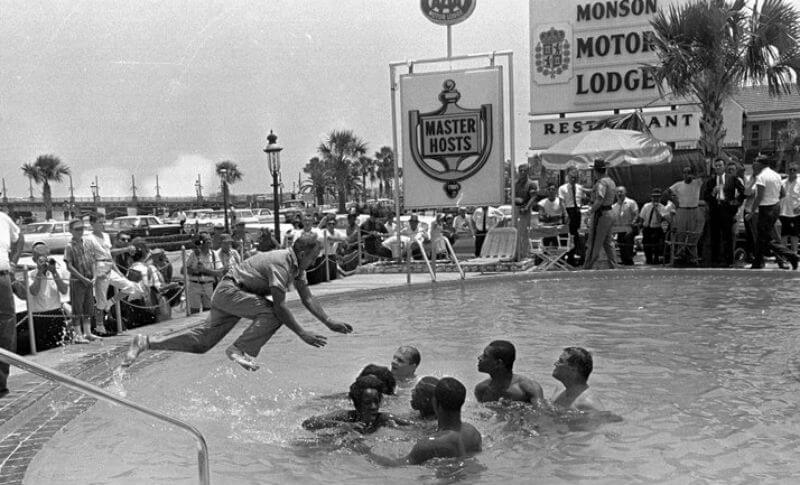
Photo Courtesy of floridahumanities.org
One of the most dramatic chapters of St. Augustine’s civil rights history unfolded at the Monson Motor Lodge on the bayfront. On June 11, 1964, Dr. King and other SCLC leaders entered the motel’s segregated restaurant and requested service. When they refused to leave after being denied, they were arrested by police. King spent the night in the St. Johns County Jail, and images of his arrest quickly made national headlines.
Just days later, on June 18, protesters staged an integrated “wade‑in” at the Monson Motor Lodge swimming pool. In response, motel manager James Brock poured muriatic acid into the pool while demonstrators were still in the water. Photographs of the incident were broadcast worldwide and became some of the most iconic images of the Civil Rights Movement, shocking viewers and intensifying public pressure on lawmakers.
Although the Monson Motor Lodge was demolished in 2003, its significance has not been erased. The original front steps where Dr. King was arrested have been preserved and are displayed at the Hilton hotel now occupying the site. A historical marker explains the events that took place here, ensuring that this pivotal location remains part of St. Augustine’s historical landscape.
Plaza de la Constitución and the Foot Soldiers
The city’s historic plaza became a modern battleground where ordinary citizens confronted extraordinary hatred with nonviolent resolve.
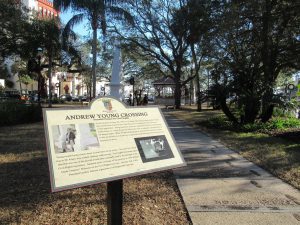
The Plaza de la Constitución, St. Augustine’s historic central square, served as a frequent gathering point for civil rights marches and demonstrations. Protesters often walked from Lincolnville to the Plaza, facing verbal abuse, physical attacks, and arrests along the way. National media coverage of these confrontations helped expose the depth of resistance to desegregation in St. Augustine.
Within the Plaza stands the Old Slave Market pavilion, a structure that, while not historically used for slave sales, became a powerful symbolic site during the movement. Protesters gathered here to speak, sing freedom songs, and reaffirm their commitment to nonviolent resistance.
Today, the St. Augustine Foot Soldiers Monument occupies the southeast corner of the Plaza. Unveiled in 2011, the monument honors the hundreds of ordinary citizens—known as foot soldiers—who marched night after night despite threats and violence. Bronze plaques embedded in the sidewalk and sculptural elements commemorate their bravery and remind visitors that lasting change was achieved through collective action.
The Plaza also recognizes the leadership of Andrew Young, a key aide to Dr. Martin Luther King Jr. and a future U.S. Ambassador to the United Nations, congressman, and mayor of Atlanta. Young led several demonstrations in St. Augustine and was brutally attacked by a white mob during one march to the Plaza, an incident that drew national attention. Today, a plaque in the Plaza de la Constitución honors Young’s role in the local movement and his lifelong commitment to civil rights, marking the site as one where national leadership and local courage intersected.
Dr. Robert B. Hayling and Movement Leadership
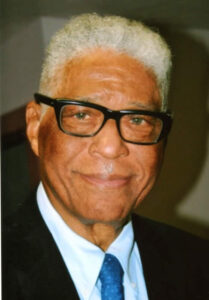
Photo courtesy of Accord Freedom Trail
Long before national leaders arrived, one local dentist helped ignite a movement that could no longer be ignored.
Dr. Hayling’s dental office in Lincolnville served as an informal headquarters for organizing protests and coordinating strategy. From this modest space, Hayling advised youth activists, worked with the NAACP, and collaborated with SCLC leaders during King’s visits.
Hayling’s leadership came at a steep personal cost. After publicly stating that activists had armed themselves for protection, his home was repeatedly targeted, and his family faced ongoing threats. Eventually, the violence forced him to relocate his dental practice and family to South Florida. Though recognition came slowly, St. Augustine later honored Hayling’s legacy by renaming a street in Lincolnville in his memory.
Safe Houses and Community Support
Behind every public march and arrest stood a quieter network of residents who made the movement possible.
During his time in St. Augustine, Dr. King stayed at multiple locations for security reasons, moving between homes as threats intensified. Several residences associated with King’s visits are marked today, though many remain privately owned and should be viewed respectfully from the street.
These homes represent the broader network of local support that sustained the movement. Residents opened their doors to activists, provided meals, hosted meetings, and risked retaliation simply by offering shelter. Their contributions, though often unrecorded, were essential to the success of the movement.
Fort Mose: A Longer Arc of Freedom
St. Augustine’s role in the fight for freedom did not begin in the 1960s—it stretches back nearly three centuries.
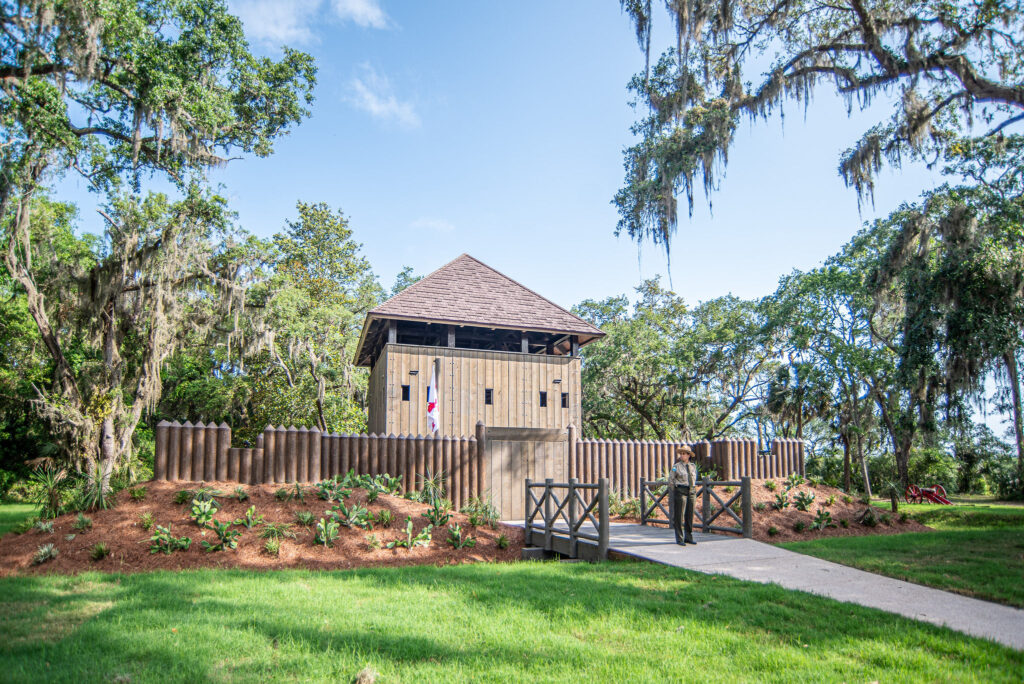
Photo courtesy of, Fort Mose Historical Society.
While not directly tied to the 1960s movement, Fort Mose Historic State Park provides essential historical context. Established in 1738, Fort Mose was the first legally sanctioned free Black settlement in what would become the United States. Enslaved people who escaped British colonies to Spanish Florida were granted freedom in exchange for military service.
The story of Fort Mose demonstrates that St. Augustine’s connection to Black freedom and resistance stretches back centuries. Visiting the park today offers a broader perspective on why the city became such a powerful stage for civil rights activism in the twentieth century.
Experiencing Civil Rights History Today
Many of the most important civil rights sites remain woven into the fabric of everyday life in Old City.
Visitors can explore many of St. Augustine’s civil rights sites on foot, particularly in Lincolnville and the historic downtown area. Guided tours offered by the Lincolnville Museum and organizations such as the ACCORD Freedom Trail provide deeper insight and historical context.
Martin Luther King Jr. Day in January is an especially meaningful time to visit. Cooler temperatures make walking comfortable, and the holiday invites reflection on the sacrifices made here and across the nation.
A Legacy That Endures
The passage of the Civil Rights Act marked a turning point, not a conclusion, for St. Augustine.
St. Augustine’s civil rights story did not end with the signing of the Civil Rights Act in 1964. Desegregation faced resistance, and the struggle for equality continued long after the cameras left. In recent decades, the city has taken steps to more fully acknowledge this chapter of its history through monuments, museum exhibits, and educational programs.
Walking these streets today offers more than a history lesson. It is a reminder that progress is rarely easy and that ordinary people—students, parents, neighbors—can shape the course of history through courage and persistence.
This Martin Luther King Jr. Day, we invite you to explore Old City with fresh eyes. Visit the places where history was made, honor those who marched for justice, and reflect on how their legacy continues to shape St. Augustine and the nation today.
The stories preserved here are not confined to the past. They live on in the streets, neighborhoods, and institutions that continue to shape the city. By remembering what happened in St. Augustine—and why it mattered—we honor the individuals who stood firm in the face of hatred and help ensure that their sacrifices continue to inform the ongoing pursuit of justice and equality for generations to come.
Disclaimer: Every effort is made to ensure the accuracy of the information in this article. Please credit OldCity.com when sharing and re-posting.